


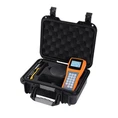

Hey there! As a supplier of Digital Display Shore Hardness Testers, I often get asked about how these nifty devices work. So, in this blog post, I'm gonna break down the principle of a Digital Display Shore Hardness Tester for you.
First things first, let's talk about what hardness actually means in the context of materials. Hardness is a measure of a material's resistance to permanent indentation. It's a crucial property, especially when it comes to choosing the right materials for various applications. For instance, if you're making a mobile phone case, you'd want a material that's hard enough to withstand impacts but not so hard that it becomes brittle.
The Digital Display Shore Hardness Tester is a handy tool used to measure the hardness of rubber, elastomers, and some plastics. The "Shore" in the name refers to the Shore scale, which is a standard way of quantifying the hardness of these soft to semi - rigid materials. There are different Shore scales, like Shore A and Shore D, each designed for materials with different hardness ranges. Shore A is generally used for softer materials like rubber bands and gaskets, while Shore D is for harder plastics and hard rubbers.
So, how does the Digital Display Shore Hardness Tester work? Well, it all boils down to the principle of indentation. The tester has an indenter, which is a small, precisely shaped tip. When you apply the tester to the material you want to test, the indenter is pressed into the surface of the material under a specific force.
The force applied by the tester is standardized. For example, in the case of a typical Shore A tester, the total test force is usually 10N. This force is applied gradually, and the depth of the indentation created by the indenter in the material is measured. The harder the material, the less it will deform under the force, and the shallower the indentation will be. Conversely, a softer material will deform more, resulting in a deeper indentation.
The Digital Display Shore Hardness Tester uses a sensor to measure the depth of this indentation. This sensor is connected to a digital display, which then shows the hardness value on a scale. The scale is calibrated according to the Shore scale standards. For example, a very soft rubber might have a Shore A hardness value of around 10 - 20, while a harder rubber or a semi - rigid plastic could have a value of 80 - 90 on the Shore A scale.
One of the great things about digital display testers is their accuracy. They can measure the indentation depth very precisely, which means you get a more accurate hardness reading compared to some older, analog models. The digital display also makes it easier to read the results, especially in different lighting conditions.
Now, let's talk a bit about the different types of hardness testers we offer as a supplier. Alongside our Digital Display Shore Hardness Testers, we also have a range of other hardness testers, such as the Integrated Pen Type Leeb Hardness Tester, the Portable Leeb Hardness Tester, the Leeb Hardness Tester, and the Ultrasonic Hardness Tester. Each of these testers has its own unique principle and is suitable for different types of materials and applications.
The Leeb hardness testers, for example, work on the principle of dynamic impact. A small impact body is propelled against the material surface, and the velocity of the impact body before and after the impact is measured. The ratio of these velocities is then used to calculate the hardness of the material. This type of tester is great for testing large or heavy workpieces, as it doesn't require the workpiece to be moved to a testing machine.
The Ultrasonic Hardness Tester, on the other hand, uses the ultrasonic contact impedance (UCI) method. It measures the change in the resonance frequency of an ultrasonic transducer when it's in contact with the material. The hardness of the material affects this resonance frequency, allowing the tester to calculate the hardness value. This type of tester is ideal for testing small or thin - walled parts, as well as parts with complex shapes.
If you're in the market for a hardness tester, whether it's a Digital Display Shore Hardness Tester or one of our other models, we can help you find the right one for your needs. Our team of experts has years of experience in the industry and can provide you with all the information and support you need.
Whether you're a manufacturer looking to ensure the quality of your products, a researcher studying materials properties, or an engineer working on a new project, having the right hardness tester is essential. With our range of high - quality testers, you can be confident that you're getting accurate and reliable results.
So, if you're interested in learning more about our Digital Display Shore Hardness Testers or any of our other products, don't hesitate to reach out. We're more than happy to have a chat with you, answer your questions, and help you with your procurement needs. Get in touch with us today to start the conversation about finding the perfect hardness tester for your application.
References


- ASTM D2240 - Standard Test Method for Rubber Property - Durometer Hardness.
- ISO 868 - Plastics and ebonite -- Determination of indentation hardness by means of a durometer (Shore hardness).